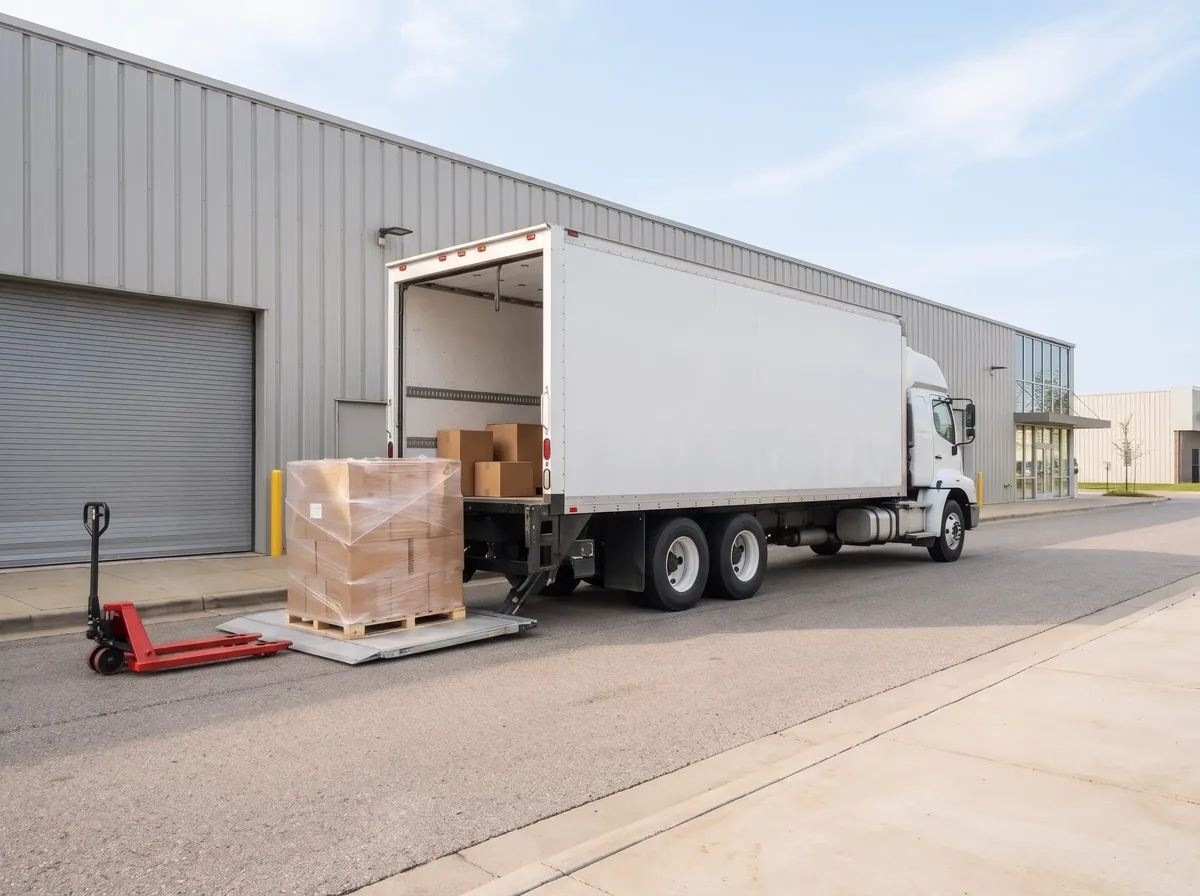
What a lift gate does
A lift gate is a powered platform on the back of a truck. The driver rolls a pallet onto it with a pallet jack, the platform lowers it from the height of the truck bed to the ground, and the pallet jack rolls it the rest of the way. No dock and no forklift are needed at the delivery end.
That makes a lift gate the standard answer for stores, offices, schools, churches, job sites, small warehouses and homes: anywhere a 53-foot trailer cannot back up to a dock.
Before you book
Answer these with the carrier when you book, not when the truck arrives:
- Is there a dock at either end? If the pickup has a dock and the delivery does not, say so. The gate is only needed where there is no dock.
- What does the heaviest pallet weigh? Every lift gate has a rated capacity. A pallet over the rating cannot go on the gate.
- What size are the pallets? A standard pallet is 48 by 40 inches. Oversized or overhanging freight may not fit the platform.
- How tall is the load? Tall, top-heavy pallets need extra care on a moving platform.
- Is there a delivery window? Many businesses only receive at certain hours.
The ground at the delivery end
The gate lowers the pallet to whatever is under the truck, and a pallet jack has to roll it from there. Check:
- Flat and hard. Concrete or asphalt is ideal. Grass, gravel, mud and steep driveways stop a pallet jack.
- Room to park. The truck needs space behind it for the platform to come down, plus room to roll the pallet off.
- A clear path. Steps, curbs without a ramp, narrow doorways and tight hallways all stop a pallet. Measure the doorway if you are unsure.
- Overhead clearance. Low branches, wires and canopies where the truck parks matter for a box truck too.
On the day
- Have someone there to receive the freight and sign for it.
- Count the pallets and look at the wrap before you sign. Note any damage on the delivery receipt.
- Keep the path from the truck to the drop point clear of cars and people.
What a lift gate cannot do
A lift gate is not a forklift. It lowers freight to ground level at the back of the truck; it does not lift it onto a shelf or carry it up stairs. Pallets over the gate's rating, freight longer than the platform, and loose items that are not on a pallet all need a plan of their own.
Questions
When do I need a lift gate?
Whenever the pickup or delivery address has no loading dock and no forklift. The gate lowers each pallet from the truck bed to the ground so a pallet jack can move it.
How much weight can a lift gate handle?
It depends on the gate. Lunar's trucks carry a lift gate on every truck that lifts up to 1,500 lbs and lowers up to 2,000 lbs, so confirm your heaviest pallet against those numbers when you book.
Can a lift gate deliver to a residence?
Yes, as long as the truck can park on a flat, hard surface and there is a clear path to where the freight is going.
Delivering without a dock?
Lunar Logistics runs straight box trucks out of Charlotte with a lift gate, straps, load bars and a pallet jack on every truck, and a dock-high option when both ends have docks. See how a shipment moves, read box truck vs. dry van, or tell us the pickup and delivery.