The short version
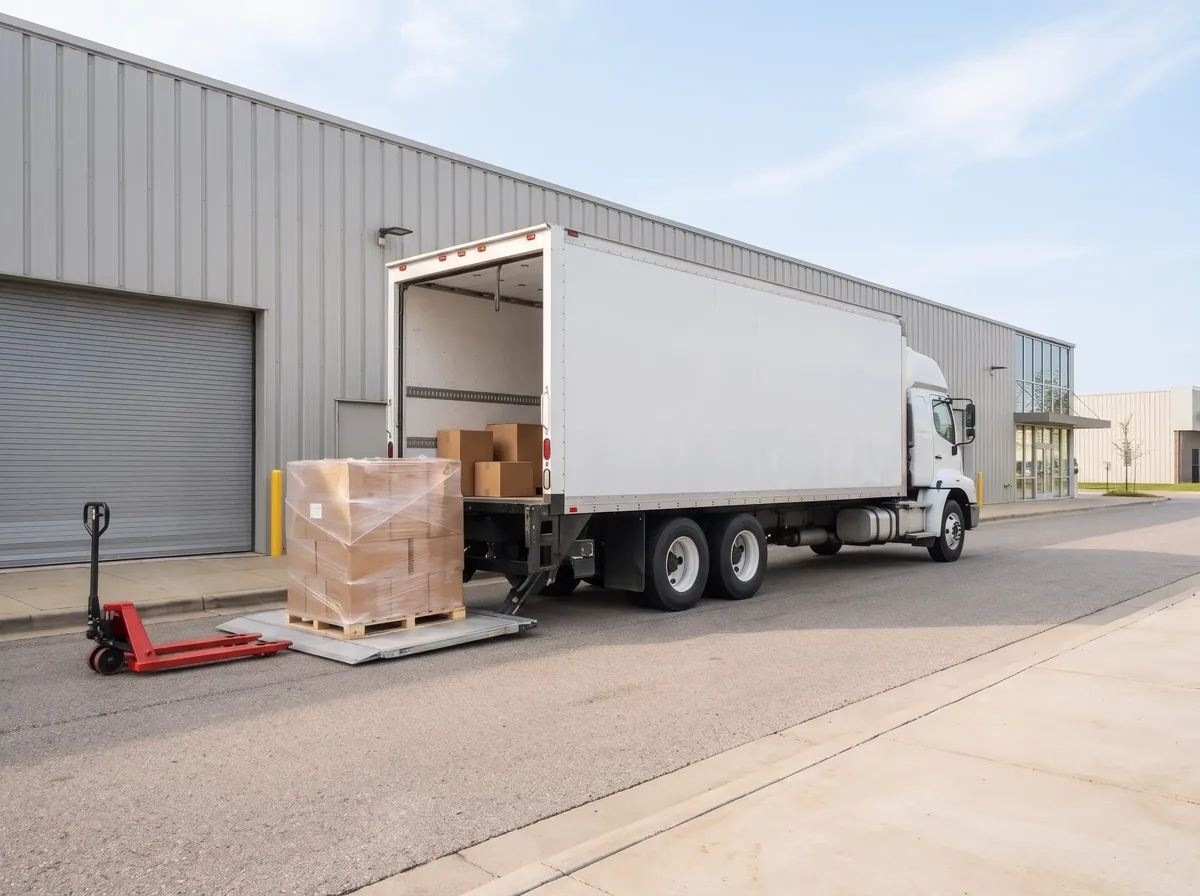
A straight box truck is a single vehicle: the cab and the cargo box share one chassis. A dry van is an enclosed trailer pulled by a separate tractor. That one difference shapes everything else: size, where the truck can go, and how it loads.
| Straight box truck | 53-foot dry van | |
|---|---|---|
| Typical load | 1 to 12 standard pallets | About 26 standard pallets on the floor |
| Loading | Lift gate at the curb, or a dock-high option | Needs a loading dock or a forklift |
| Access | City streets, business parks, tight lots | Highways and truck-friendly docks |
| Best for | Partial loads, urgent runs, no-dock deliveries | Full truckloads between warehouses |
When a box truck is the better choice
You have a partial load. Paying for a 53-foot trailer to carry four pallets means paying for space you do not use. A box truck carries 1 to 12 pallets without wasting a full trailer.
There is no loading dock. Many stores, offices, job sites and small warehouses have no dock at all. A box truck with a lift gate lowers each pallet to the ground and a pallet jack rolls it inside.
The freight cannot wait. On an exclusive-use run, your freight is the only thing on the truck and it goes straight to the destination, with no terminal stops along the way. That is what manufacturers use to pull inventory when a line cannot stop.
The route is tight. Downtown streets, older business parks and residential delivery addresses are far easier for a straight truck than for a tractor-trailer.
When a dry van makes more sense
A dry van wins on volume. If you are moving a full truckload between two docks, for example from a distribution center to a retailer's warehouse, a 53-foot trailer carries roughly twice what a box truck can, so the cost per pallet drops.
Lift gates, docks and what to tell your carrier
Before you book, check both ends of the trip:
- Does the pickup have a dock, or will the pallets come off a forklift at ground level?
- Does the delivery address have a dock? If not, you need a lift gate.
- What do the heaviest pallets weigh? A lift gate has a rated capacity.
- Is there a delivery window or an appointment to meet?
Lunar Logistics runs straight box trucks out of Charlotte that haul up to 10,000 lbs, with a lift gate on every truck that lifts up to 1,500 lbs and lowers up to 2,000 lbs, plus straps, load bars and a pallet jack on board.
Questions
How many pallets fit in a box truck?
Straight box trucks commonly carry 1 to 12 standard pallets, depending on the length of the box and the size of the pallets. Lunar's trucks take 1 to 12 pallets and up to 10,000 lbs.
Do I need a loading dock for a box truck delivery?
No. A lift gate lowers each pallet from the truck bed to the ground, so a box truck can deliver to a curb, a parking lot or a building without a dock.
Is a box truck cheaper than a dry van?
For a partial load, usually yes, because you are not paying for an empty 53-foot trailer. For a full truckload, a dry van usually costs less per pallet.
Need a box truck in the Southeast?
Lunar Logistics is based in Charlotte and runs expedited, same-day and LTL freight across North Carolina, South Carolina, Georgia, Virginia, Tennessee and Alabama. Tell us the pickup, delivery, pallet count, weight and timing, and we will tell you the right truck.